

TDP
RCA BHF-50B


GENERAL DESCRIPTION


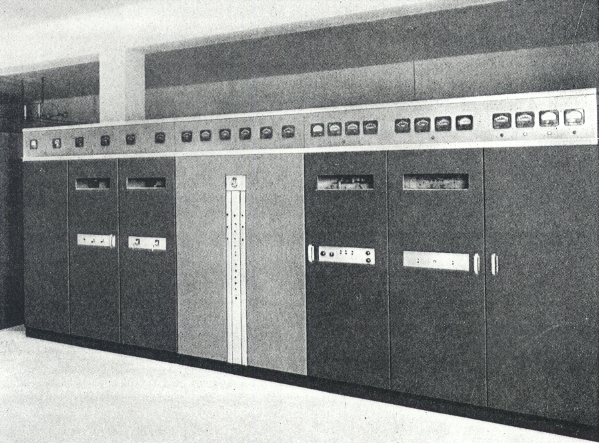
H. F. Broadcast Transmitter, Type BHF-50B 50 KW High Frequency Broadcast Transmitter

photo RCA BHF-50B FEATURES

  • Entirely air cooled
  • High stability grounded grid amplifiers
  • Quick frequency change
  • High level modulation by Class B modulator
  • Low operating cost-low power consumption
  • Conservative operation of all parts and tubes
  • Small floor space requirements-reduces installation and building construction costs
  • Built in wiring ducts-minimizes conduit and wire trenches-low installation cost
  • Simplified effective control with high speed air circuit-breakers
  • Simplified power supply-only one main mid-voltage tap rectifier, one auxiliary and one bias rectifier
  • Single phase filament heating of all vacuum tubes
  • Motor driven tuning-essential circuit metering
  • Breaks down into small units for ease of transportation and installation
  • Sectional fault indication on front panel enclosure
  • Non-critical, low distortion performance obtained by audio feedback in connection with a cathode follower driver for the modulator
  • Attractive appearance achieved by functional styling
  • Vertical chassis construction for accessibility and maximum ventilation
  • Supervisory control console constructed of build-up sections

    DESCRIPTION

    General

    The new RCA type BHF-50B transmitter is an all air cooled 50-kw amplitude modulated shortwave broadcast transmitter featuring a number of RCA's latest developments, as well as time tested features which have proven their worth. Of particular interest is the use of a grounded grid power amplifier with consequent circuit simplicity and stability. Two of the outstanding features are the small floor space requirements and ease of installation of the transmitter. The transmitter is designed for high fidelity transmission in the frequency band of 3.9 to 22 megacycles and the frequency band of 25.6 to 26.1 megacycles. Radio stations of this class usually have long operating schedules which permit minimum time off for servicing and maintenance. This point has been given careful consideration in the layout and design of the BHF-50B.

    Mechanical Design

    The general arrangement of the transmitter consists of a series of self-supporting chassis in line with a front enclosure to form a unified front panel. A typical floor plan permits installation of the radio frequency portion of the transmitter in a space sixteen and one-half feet long by nine feet deep. Disposition of the power equipment and blower may be made to make the optimum use of existing building space. All equipment is dead-front constructed, with doors in the front enclosure allowing free access to the driver and P.A., R.F. cabinets, modulator and to the transmitter area. With the transmitter "on the air", station personnel can walk behind the enclosure and around the individual units for close inspection without fear of coming in contact with dangerous voltages.

    Single Unit

    All incoming power supply and high power rectifier switch gear along with lower power distribution circuits, contactors, and control relays are centralized in a single unit. This unit also contains the filament voltage regulator and distribution transformers.

    For installation, the transmitter can be broken down into units no larger than 50 x 521/2 x 84 inches, with the exception, in height, of the modulation transformer and reactor, which will be approximately 92 inches high.

    Operational controls, indicating instruments, indicator lights and tuning controls are located on the front panel at appropriate intervals. Tuning operations required for normal daily adjustments are remotely controlled by front panel key switches controlling motor drives on the tuning elements. Power amplifier tuning controls are conveniently located with respect to the corresponding meters for easy viewing of d-c power input and R.F. output during tuning operations.

    Control Console

    The supervisory control console is designed to be set up in a convenient position in front of the transmitter. Essential operational controls and indicator lamps are duplicated on the R.F. turret of the console. The audio turret of the console has all controls for program handling. Space and mounting convenience has been provided in the R.F. turret for mounting three 4-inch meters in a recessed position behind the front panel, the choice of the meters being left to the discretion of the station personnel. The control console is of the sectionalized type which provides for adding further sections for associated usage, such as antenna switching controls, another HF, MF or FM transmitter control, paralleling controls, etc.

    Frequency Source

    Most customers prefer to supply their own frequency source. In some cases transmitters are driven from a central control room. A Frequency Source, therefore, has not been included in the equipment supplied with the transmitter. RCA can supply an external Frequency Source to drive the transmitter and lists one under the accessories.

    Mechanically Operated Tube Hoist

    Tube changing in the driver and power amplifier and modulator is facilitated by the use of a mechanically operated tube hoist, solidly mounted in a swivel supporting structure and suitably located for easy access to the high power tubes. Swivel supports are provided. The hoist can be easily lifted from one support to the other, depending upon which tube is to be removed. Minimum tube change time is assured by use of quick opening clamp type filament connectors.

    Radio and Audio Frequency Circuit Design

    Simplified single ended circuits are used throughout. An output circuit consisting of a capacity tuned, single turn primary and a capacity tuned, double turn secondary is used to control the power amplifier loading and to convert the unbalanced output of these amplifiers to balanced output. Radiation cooled, shielded grid type tubes are used in the low power r-f and a-f stages while forced air cooled triodes are used in all subsequent stages above the 250 watt r-f level and the modulator. High stability grounded grid amplifiers are used for all r-f stages above the 250 watt level. Only three tube types are used in the r-f amplifiers. Completely shielded construction in the higher power stages and use of grounded grid circuits leads to complete stability and freedom from operation discrepancies. The complete shielding of the r-f stages and the design of the power amplifier tank circuit and output coupling network reduces harmonic radiation to a minimum.

    The audio section of the transmitter employs push pull circuits throughout with fixed overall audio feedback. This design results in a very stable system having excellent fidelity characteristics with very low distortion and noise level. A total of three stages of audio amplification are employed, the third of which is a highly efficient cathode follower circuit. High level, Class B modulation is employed resulting in further economy of equipment and operation.

    All filaments are heated with power frequency a-c voltage and filament voltages are maintained within specified limits by means of an automatic induction regulator. Single phase filaments are used in all tubes resulting in greater tube life. All high power tubes have thoriated tungsten filaments, with subsequent saving in filament power.

    Rectifiers

    A total of three rectifiers are employed in the BHF-50B.

    1. A single phase full wave unit, using two mercury vapor rectifier tubes to supply plate and screen voltage for the low power a-f tubes.

    2. A single phase bridge connected unit, using two metallic rectifier sections to supply bias voltage for the cathode follower and modulator tubes.

    3. A three phase full wave, high voltage rectifier, with a mid-voltage tap, which supplies plate and screen voltage for all r-f screen type tubes and plate voltage for all triode r-f power tubes and the modulator tubes. This rectifier has a preheated spare tube which may be switched into the circuit manually. The plate transformer is an air cooled three-phase unit with extended windings on the primary to provide reduced voltage for test and tune-up purposes.

    Metering

    All essential indicating instruments are located along the top front of the enclosure and are the 4-inch square faced type meters with black background. Less important meters are located behind the enclosure and may be viewed through windows while the transmitter is in operation.

    High-speed air circuit breakers of the hum free mechanical latch type are employed in all high power switchgear. Overload protection consists of a selective relay system combining high speed tripping on d-c overloads and short circuit faults, with time delay tripping on nominal a-c system overcurrent and under-voltage faults.

    The control system is carefully engineered to provide proper starting sequence and automatic protection against most operating faults. Circuit indicator lamps provide a quick means for analyzing and localizing transmitter, tube or line faults, etc. A reclosing system will return full power automatically if the plate voltage is removed due to operation of overload devices on rectifier backfires, vacuum tube gas arcs, antenna flash-overs or other causes. This operation is repeated three times. If the fault persists on the third re-application of plate voltage, the recloser will lock out until reset manually.

    All power circuits are doubly protected by high speed overload relays and air circuit breakers. In addition, a special hold-in circuit is provided which permits the transmitter to return instantly to the air in case of a momentary power line failure, thus avoiding the delay required for the plate time-delay relay to operate.

    Installation

    Ease of installation and good utilization of building space is a feature of the BHF-50B. Being air cooled, no plumbing is required, and its design is such that virtually no wiring trenches or conduit need be used. All interconnections are made in either built in or overhead ducts or conduits, so that the only conduits or trenches required are those for the supervisory console and incoming power. While the plan view shows an under floor air duct and depressed level blower room, both the air duct and blower may be above floor level with only slight inconveniences on accessibility to units located to the rear. Units are designed as sub-groups for economy of floor space and wiring materials, leading to economy of installation labor as well.

    Safety

    All possible precautions have been taken to provide maximum safety to operating personnel. All doors permitting access to high voltage circuits or equipment are interlocked to remove high voltage and to operate a grounding switch on the high voltage bus. In addition, grounding sticks are provided in each enclosure where high voltage is present.

    TECHNICAL SPECIFICATIONS
    Type of Emission A 3 (telephone)
    Output Frequency Range Any frequency within the ranges 3.9 to 22.0 mc; and 25.6 to 26.1 mc
    Stability Determined by frequency source
    RF Power Required from External Frequency Source 2 watts minimum
    Power Output Not less than 50 kw for frequency range of 3.9 to 22.0 mc
    Not less than 40 kw for frequency range of 25.6 to 26.1 mc
    Modulation High level Class B
    Capability 400 Cycles : Not less than 100 per cent
    50 to 7500 Cycles : Not less than 90 per cent
    Audio Frequency Response ±2 db 30 to 10,000 cycles (Input reference level corresponding to 60 per cent modulation at 1000 cycles)
    Residual Modulation (100% Modulation) 56 db below 100 per cent modulation
    Envelope Distortion Less than 4.0 per cent rms (with 90 per cent modulation at 1000 cycles)
    Input Impedance 600 ohms
    Input Level Required for Full Modulation (400 cycles) +10 ±2 dbm
    R-F Output Load Impedance 300 to 600 ohms resistive
    Power Sources For Main Supply: 460 volts, 50 cycles, 3 phase, 3 wire. Allowable regulation 5.0 per cent. Allowable total voltage variation including regulation, 46 volts.
    For Auxiliary Supply: 115 volt, 50 cycle, single phase, approximately 500 watts
    Power Consumption (less Auxiliaries) 0% Modulation : 110 kw
    30% Modulation : 125 kw
    100% Modulation : 165 kw
    Power Factor (at 100% Modulation) At least 90 per cent
    Specifications may change without notice

    TUBE COMPLEMENT
    RF stages AF stages and modulator Rectifiers
    Number Type Number Type Number Type
    3 9C25 2 9C25 6 857B
    1 5762 8 813 2 8008
    3 4E27A 2 4E27A


    2 807


    THIS TYPE OF TRANSMITTER IS INSTALLED IN THE FOLLOWING COUNTRIES

    ITU Country
    ITU Country
    flag AUS AUS AUSTRALIA flag CLM CLM COLOMBIA
    flag POR POR PORTUGAL